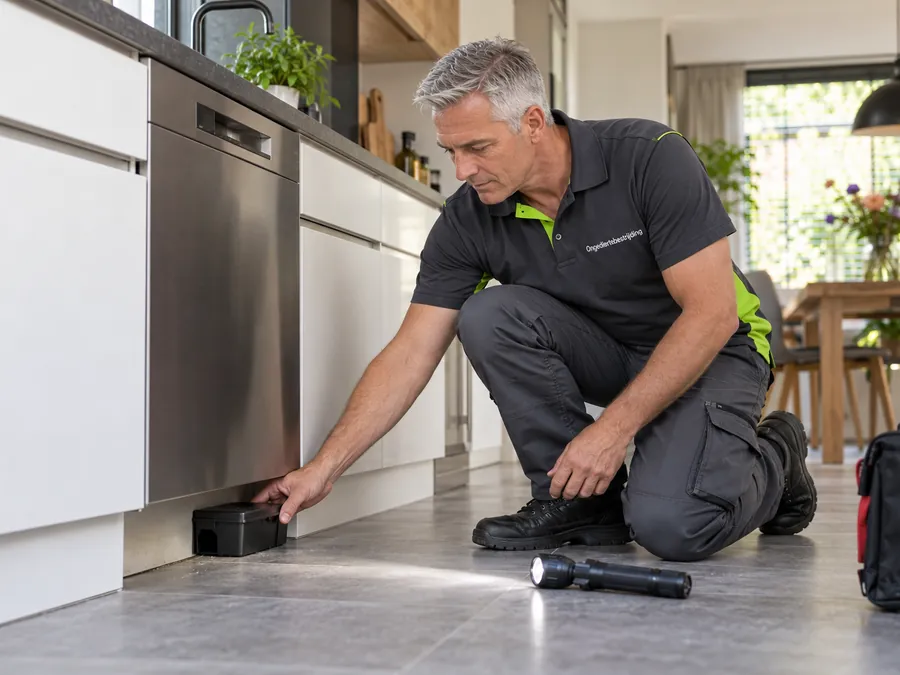
Mouse control in Eindhoven: the first signs
You rarely see the mouse itself; mice are most active when it is dark and quiet. What they leave behind gives them away. Look out for:
- small dark droppings, about the size of a grain of rice, in cupboards and along skirting boards
- gnaw marks on packaging, soap, cables or insulation
- rustling and scratching in the ceiling, walls or crawl space, often in the evening
- shredded paper, fabric or insulation in a sheltered corner: a nest
- a sharp, stale smell of urine in closed cupboards
Fresh droppings in several rooms usually mean you are no longer dealing with a single mouse.
How mice get into your home
A mouse needs a gap of only about 6 mm. You will often find one around pipes running into the crawl space, by the meter cupboard, under a garage door, behind a loose skirting board or at the eaves, where mice climb up the brickwork. Air bricks with coarse openings let them through too.
Autumn is when mice go looking for warmth and food. Birdseed, a bag of dog food in the shed or a compost heap close to the house makes a garden especially appealing. In other words, they come in not because your home is dirty, but because there is a way inside.
Our approach: seal first, then trap
Trapping on its own only helps for a while: as long as the entrance stays open, new mice will follow. That is why we start with an inspection of the facade, crawl space, meter cupboard and kitchen. We close openings with materials mice cannot gnaw through, such as steel wool, wire mesh or mortar. Expanding foam or sealant alone will not stop them.
Then comes targeted control. Indoors we mainly use snap traps along their runs; outside or in the crawl space, locked bait boxes where needed. Professional rodenticides may only be used by certified pest controllers. Curious about the other pests we handle? Have a look at our pest control in Eindhoven services.
Doing it yourself: what helps and what does not
There is plenty you can do to make life harder for mice. Keep cereal, rice and pet food in sealed containers, do not leave the cat's food bowl out overnight and hang the bird feeder well away from the house. Tidy up the shed and crawl space so there are fewer places to nest.
What we advise against is scattering loose poison pellets from the supermarket around the house. A child or pet can get to them, and a mouse that dies inside the cavity wall will start to smell. Do not simply block every hole while mice are still indoors either, or they will die in the walls or gnaw a new way out. Have the route identified first.
Mouse or rat? The difference matters
Mouse droppings are small and slender. If the droppings you find are a lot bigger, you notice tunnels in the garden or hear heavier thumping, you may have rats. A young rat looks like a mouse, but has a thicker head and bigger feet in proportion to its body.
Rats often come in through the sewer or a broken drain and need a different approach, which you can read about on our rat control page. If in doubt, leave the droppings where they are. During the inspection we establish which animal it is, so we choose the right method from the start.